

Your child is smart, but something keeps getting in the way when they sit down to read. Letters look jumbled, words seem to shift on the page, and keeping up with classmates feels like a constant uphill battle.
It’s easy to assume dyslexia is the answer, but that’s not always the full picture. At Heartland Eye Consultants, we work with families navigating exactly these kinds of concerns. If your child is struggling, understanding how vision problems can affect reading is the right place to start.
Some children who struggle with reading may actually have a functional vision problem rather than dyslexia. Knowing the difference can change how your child gets help and how quickly the issue improves.
What Dyslexia Actually Is
Dyslexia is a neurological condition, meaning that it starts in the brain, not the eyes. It affects how the brain processes language, which makes reading, spelling, and writing more difficult. It has nothing to do with intelligence or how hard your child tries.
Signs That Show Up at Different Ages
Red Flags in Younger Children
In younger kids, dyslexia often shows up as trouble connecting letters to their sounds. Your child might mix up common word patterns, confuse similar-sounding words, or struggle to recognize letters they’ve seen many times. These early signs can be easy to brush off as normal development, but they’re worth paying attention to.
Signs in School-Age Kids & Teens
As kids get older and reading demands increase, the signs become harder to ignore. You might notice your child:
- Reversing letters or reading words backward
- Struggling to remember spelling rules or basic math facts
- Reading below their grade level
- Losing their place on the page while reading

These patterns tend to persist across different subjects and don’t improve much with extra practice. Keeping an eye out for warning signs that your child may have a vision problem can help you figure out how to proceed.
Vision Problems That Look Like Dyslexia
Functional Vision Problems
When the eyes don’t work together properly, reading becomes a challenge. Words can appear to move, blur, or overlap, an outcome reminiscent of dyslexia. Poor eye tracking can also cause your child to skip words, lose their place, or re-read the same line of text repeatedly.
The tricky part is that your child may never complain about their vision. To them, this is just what reading feels like. They don’t know that it could be different.
Common Functional Vision Issues
A few specific conditions are often behind these reading struggles:
- Convergence insufficiency: the eyes focus on different points, making letters appear doubled or unstable
- Accommodation problems: difficulty shifting focus between distances, like moving from a book to the board
- Poor visual memory & processing: slows reading down even when the eyes appear healthy
None of these show up on a standard school vision screening. In fact, in many cases, learning-related vision disorders are only discovered years after families start searching for answers.
Dyslexia vs. Vision Problems: Key Differences
The most important thing to understand is that dyslexia is language-based, while functional vision problems are rooted in how the eyes move and work together. One affects how the brain decodes words; the other affects how clearly and steadily the eyes deliver information to the brain in the first place.
It’s also worth knowing that a child can have both at the same time. Only a thorough evaluation can give you a clear picture of what’s actually happening with your child’s vision.
Next Steps If You’re Concerned About Your Child
What a Functional Vision Exam Covers
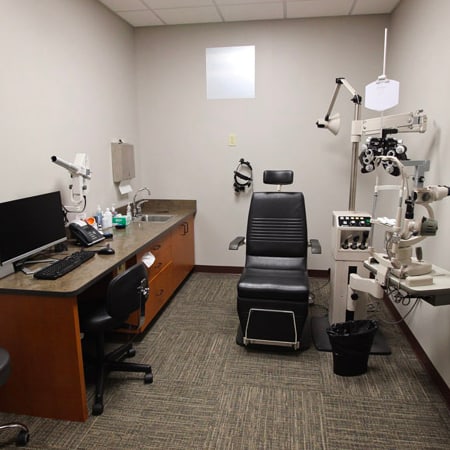
A functional vision exam goes well beyond reading the letters on a chart. It tests how well the eyes track, team up, and process what they see, skills your child uses every day in the classroom.
For a deeper look at what vision therapy can address, we’ve written up an overview of what vision therapy for kids looks like.
How Eye Doctors in Omaha Can Help
Our team at Heartland Eye Consultants takes time to understand what’s going on with your child’s eyes. A personalized evaluation can help identify whether a functional vision problem is contributing to your child’s reading difficulties, and vision therapy may help reduce or relieve certain symptoms that have been holding them back.
If your child is struggling with reading and you’re not sure where to start, a comprehensive vision evaluation is a solid first step. Reach out to us at Heartland Eye Consultants to schedule an appointment and get some real answers.